2026-09 DiSH Manchester
20/10/2026Digital Security Hub
The last time I was in Manchester on business was for the Cyber UK exhibition back in 2018. The number of cranes I could see and the construction projects going on, plus the growing hospitality places looked amazing.
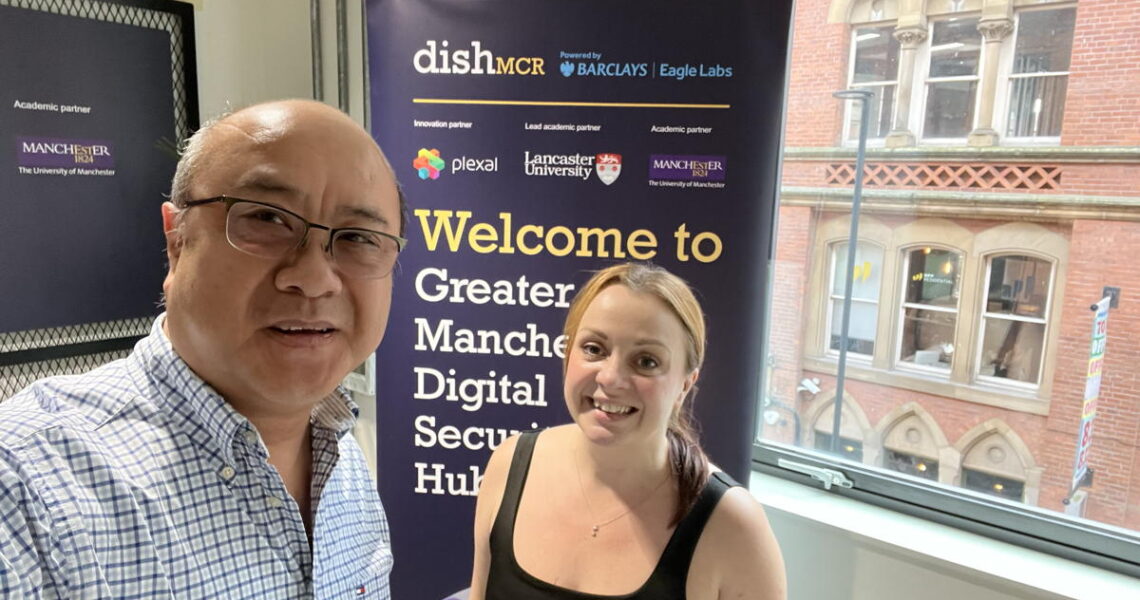
I took this opportunity whilst back in the area for an event to visit DiSH, which is the Greater Manchester Digital Security Hub.
As Barclays Eagles Labs runs the centre, I wanted to share up front is their free service to SMEs. This can be accessed by any business. It doesn’t matter if they are a customer of Barclays Bank or not.
It was September 2026 and I walked into the Heron House that has recently become home to Number 10 North. It is also houses GCHQ. As a centre for Cyber businesses, this seems very apt when it comes to building UK resilience.
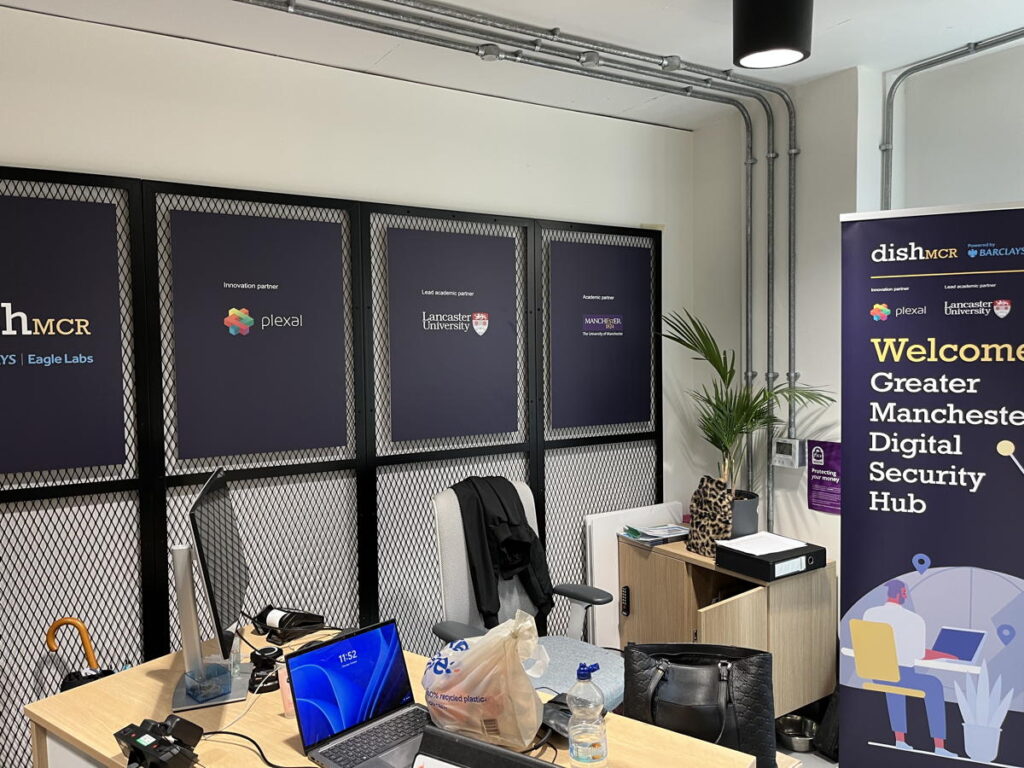
A quick explanation of the entities that make up DiSH, which is funded by Manchester City Council currently. The consortium consists of Barclays Eagle Labs who manages the facility, Plexal is the innovation partner who run the accelerator programmes, and Lancaster University and Manchester University are the academic partners.
Cisco is also a partner. This gives then access to talent and innovations as well as giving back with mentoring opportunities for startups.
It was Siobahn Gurrie who I met and explained everything, and she is the Ecosystem Manager.
Why Manchester?
Manchester has a thriving cyber and digital economy with startups, SMEs and larger corporates. It also has new businesses being spun out of Manchester University’s Innovation Factory as well as an innovation district project called Sister.
Manchester also has the second highest number of cyber jobs behind London. Factor in the Yorkshire Cyber Security Cluster and the region becomes even stronger and larger in Cyber Security.
Aims
The central goal of DiSH is to bring together business, academia and government. The triple helix model to drive innovation and economic growth. Adjacent to that was GCHQ’s need to access a diverse talent pool away from its Cheltenham bubble.
Against a backdrop of increasing global threats, the need for diverse thinking to tackle even more complex problems; as well as the need for cultural diversity to assist in the analysis of worldwide intelligence is operationally vital.
Being in the same building as DiSH gives GCHQ access to innovative businesses and talent to have secure conversations on their floor. It also acts as a gravitational point for the ecosystem.
This takes the building beyond just being a co-working space.
The Space
Within Heron House, DiSH covers 11,000 sq ft of floor space, with 13 offices and 146 hot-desking opportunities. Small businesses bootstrapping themselves can start off with hot-desks, to residential desks and onto dedicated offices before they ideally outgrow the space.
The members have developed organically and there is never an attempt to curate the range of businesses. Through the events that DiSH host with government and industry, the members have grown to know that working together; to complement each other’s offering, they can deliver a possible solution together. This level of trust can only come through a well-run facility.
Upskill and reskill the Greater Manchester community
Aside from businesses inside the building, one aim for DiSH is to engage with local schools and students. They want to bring them in for a full day on what Cyber Security is and what roles are available to them.
This is so important. In a skills meeting at another event, it was noted that if you asked school children what they would like to do when they leave school, their response can be very generic. This is because their view is bounded by what they have seen on the Internet or been told by their parents. Unless they get to hear the names of other thriving local businesses, along with the varied job roles, you will not be able to plant a seed in their mind about the future and what they can earn.
Bringing out the drones, robots and Lego games really shows them exciting possibilities.
When it comes to reskilling, AI is going to take jobs away, but DiSH wants to reskill those people into other roles that AI can’t do, or to bring people back into employment with the skills needed today. Barclays Eagle Labs have many programmes that work across a range of diverse communities.
Did you know when the GCSE course called ICT (Information and Communication Technology) was renamed to Computer Science, the level of female applicants dropped by more than half?
One thing that Siobhan and I discussed was the need to show schoolchildren the extent of different jobs that exist within the world of Cyber or IT. Parents too don’t know the range of roles within a company and so may not be able to guide their children.
Some examples of successes
One of the first companies to join DiSH were Cytix, who were two people initially and within 18 months secured their first £1.2m of funding and grew to a level that they needed to move out to larger premises, but continued to take hot desks to remain part of the community. Subsequently they raised $7m of funding.
Another example is Site Intelligence who raised £1m after about 6 months of running and have also moved to large offices, having gone from 2 people to 40 in that time.
Quantum computing is just around the corner and will come with its own massive opportunities.
I shared that I have been to Cambridge Tech Week and was amazed at the things happening there, the level of funding and even the number of innovation centres on one single science park was impressive, given that there are nearly twenty parks around the city.
I asked how Manchester competes and Siobhan replied that there is a bridge being built between Manchester and Cambridge in the metaphorical sense through The Cambridge × Manchester Partnership. It’s not about competition but collaboration, which I thought was really interesting.
https://www.cambridge-manchester.com
This seems to be recognition that not all the funding should go to the golden triangle of Cambridge, Oxford and London. There’s enough to go to other places that have the spinouts and opportunities.
We finished off my visit by chatting about how the next generation are going to face this world when they come out of education. I heard that entrepreneurship and creativity feature highly. I guess they have the tools to do this immediately than when I started in business back in the year 2000. Good luck to them indeed, because we need them to succeed.